
CTO responsibilities have expanded far past traditional executive oversight.
Modern companies face rapid shifts in technology requirements, growth pressures, and investor expectations, which push founders to reconsider how technical leadership should be structured.
Many startups and scaling organizations now compare full-time CTOs with fractional CTO arrangements to shape engineering direction, product planning, and long-term technology health.
Careful dissection of both models helps leaders choose a structure aligned with current priorities and future ambitions.
When To Choose Each Model
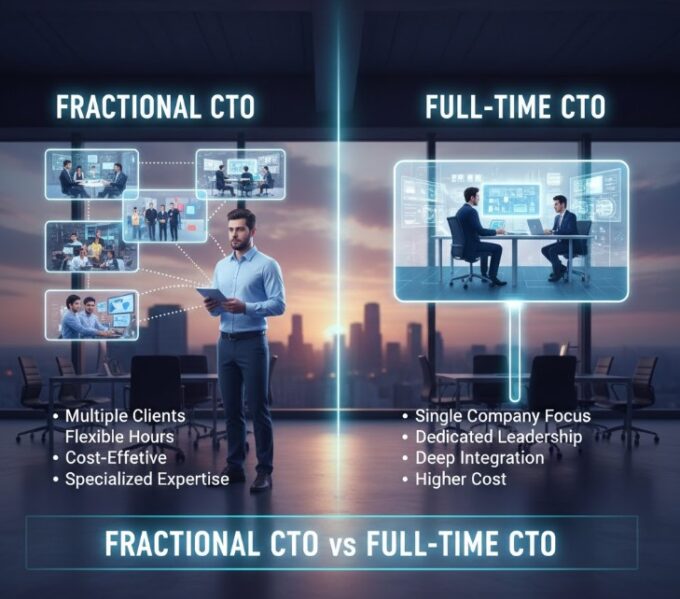
Fractional CTO vs Full-Time CTO
Early-stage needs differ sharply from scale-up requirements, so context matters significantly when selecting a leadership model.
Choose a Fractional CTO When
Startups operating under limited budgets or building early product iterations often gain the most value from a model well explained by Exec Capital Fractional CTO, which outlines the flexibility, cost efficiency, and strategic advantages this type of leadership provides.
Guidance without heavy salary commitments supports experimentation, refinement, and early architecture planning.
Companies in transition or filling a temporary leadership gap benefit as well.
Choose a Full-Time CTO When
Scaling organizations face different pressures and often require deeper involvement.
Product-market fit, revenue traction, and larger teams create an environment where continuous oversight becomes essential.
What are the Most Important Differences?
A thoughtful comparison of both models helps leaders evaluate financial commitments, operational flexibility, long-term strategy, and risk.
Cost and Equity Expectations
Source: morethanmonkeys.medium.com
Early-stage companies often rely on flexible capital allocation, which makes cost structure a primary factor.
Fractional CTO arrangements usually fit early budgets with far less strain, sometimes serving as the only viable option before revenue.
Fractional CTO engagement often falls between 60K and 180K per year for roughly 10 to 20 hours of leadership each week.
Equity expectations remain minimal, typically ranging between 0% and 0.25%.
Lighter commitments offer practical advantages during tight financial periods. Certain financial aspects often influence founder decisions, including:
- Reduced onboarding costs due to shorter start cycles
- No long-term salary liability
- Limited equity dilution compared to executive-level hires
Full-time CTO hires operate on a much higher cost tier.
Salaries often land between 200K and 400K per year or more, with equity packages commonly ranging between 1% and 5%.
Many early-stage companies find those levels challenging before achieving revenue or securing meaningful investment. Additional elements often raise long-term cost exposure:
- Possible severance obligations
- Greater equity dilution during hiring negotiations
- Higher recruiting expense due to lengthy talent searches
Flexibility and Scalability
Growth patterns shift rapidly during early and mid-stage development, so structural flexibility can influence delivery pace.
Fractional CTO services provide leaders with the ability to scale engagement up or down as demands change.
Hours can expand during product releases, architecture upgrades, fundraising cycles, or market entry phases and then contract after those peaks.
Founders testing assumptions or adjusting direction often benefit greatly from variable involvement.
Full-time CTO roles deliver continuous oversight across every initiative. Constant presence supports aggressive scale and coordination across large teams.
No ability to reduce involvement for budget control exists once hired, which can limit flexibility during downturns or strategic resets.
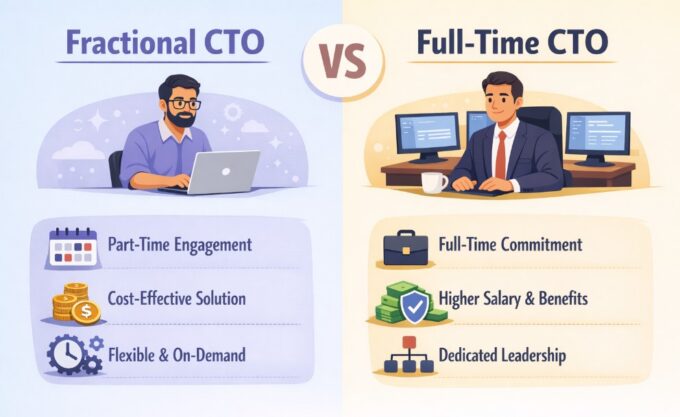
Fractional CTO vs Full-Time
Strategic Impact and Integration
Strategic clarity and cultural alignment shape organizational momentum.
Fractional CTOs introduce cross-industry experience gained through working with multiple organizations, which often helps challenge outdated assumptions and improve engineering discipline.
Many operate in advisory or tactical capacities unless explicitly engaged for hands-on leadership.
Limited presence requires deliberate actions to stay aligned with internal teams.
Full-time CTOs remain immersed in daily operations, guiding roadmap priorities, product direction, and technical design.
Strong cultural integration develops naturally through ongoing interaction with:
- Engineers
- Product teams
- Leadership
Long-term strategy, innovation processes, and execution models often mature faster under constant involvement.
Availability and Responsiveness
Urgent situations often expose clear differences between the two models.
Fractional CTOs manage multiple accounts, which can affect immediate availability during critical moments.
Structured communication routines usually maintain alignment, though sudden escalations may require coordination to ensure timely participation.
Leaders often benefit by defining expectations early, covering:
- Response windows for outages
- Meeting cadence for status updates
- Escalation paths for product issues
Full-time CTOs typically remain accessible for pressing matters such as outages, investor conversations, security incidents, and product escalations.
Ongoing presence reduces friction during sprints and contributes to higher operational confidence among engineering leads.
Team Building and Culture Fit
A strong engineering culture depends heavily on consistent leadership. Full-time CTOs often become grounding figures for teams, helping attract skilled engineers and reinforcing values through everyday interaction.
Hiring outcomes frequently improve when candidates meet a dedicated executive who represents a long-term commitment to technology.
Fractional CTOs often require more deliberate engagement to establish trust, since teams interact with them less frequently.
Clear communication, predictable involvement, and recurring touchpoints often counter early hesitation. Several approaches help increase internal adoption:
- Hosting periodic technical roundtables
- Participating in onboarding sessions for new engineers
- Providing written frameworks that guide decisions even during absence
Risk Profile
Hiring a full-time CTO naturally carries more risk due to significant compensation, equity, and long-term strategic influence.
A misaligned hire can generate tech debt, slow delivery, increase churn, and force expensive recovery measures.
Recruiting challenges amplify risk because full-time CTO searches often take six to twelve months, potentially leaving leadership gaps.
Fractional CTO partnerships reduce exposure, since contracts are easier to change or discontinue. Rapid shifts in direction, performance-based adjustments, or transitions to other specialists become easier to manage.
Many companies rely on fractional leadership as an interim solution during extended full-time searches.
Best of Both Worlds

Source: n2growth.com
Several companies adopt a staged approach, beginning with fractional leadership to craft early architecture, define engineering practices, and hire foundational talent.
Once traction builds and funding strengthens the budget, a transition into a full-time CTO role often follows.
Some organizations continue benefiting from fractional advisors even after the full-time hire to maintain continuity and preserve historical context on earlier decisions.
It’s About the Person, Not Just the Model
Technical leadership success depends on selecting someone who can translate business aims into actionable technology strategy. Strong evaluation during interviews reduces the risk of misalignment.
Key questions often help determine readiness:
- Do they grasp the company’s revenue mechanics and operational model?
- Have they scaled systems of similar volume, complexity, or compliance requirements?
- Can they communicate with clarity across engineering, product, and investor groups?
A capable leader produces strong outcomes in either arrangement, while a poorly matched leader causes issues regardless of role structure.
Summary
Optimal decision-making depends on company stage, available budget, engineering maturity, and priorities for the next one to two years.
Clear thinking about real needs, timing, and strategic targets prevents premature commitments.
No CTO involvement often creates more long-term damage than selecting a model that fits imperfectly. Early clarity and structured evaluation guide founders toward the right leadership approach for current goals and future scale.